I spent yesterday working alongside Will Kilner of Adventures With Will on a 2 star kayak training day for two clients. One of the things I enjoy the most about freelancing here in the South Wales borders is the variety of work I get to do, and yesterday was a perfect example of that.
Forwards
Both clients had some prior experience of kayaking, but little in the way of formal tuition, so we began with a look at forwards paddling. With keen students, it's so rewarding to see a really quick progression from a little swaying and meandering to really solid forwards paddling. The venue we used - the River Wye at Glasbury even enabled us to introduce a few 3 star skills as we ferry-glided across the flow, experimenting with different angles to hit different points on the opposite bank.
The Wye really is a river with something for (almost) everyone. This section is a great introduction to moving water at low levels, but lies just a few miles downstream of the Builth Wells to Boughrood section that I careered down in November.
Sideways
Safely in the shelter of a slow moving tributary, Will led a session on moving sideways and blade awareness, encouraging our students to experiment with using their paddle blades at differing angles to manoeuvre their boats. By directing their focus onto the three key elements of Body, Boat and Blade, the students began to take responsibility for their own learning, applying earlier key points to new paddle strokes with considerable success.
Upside Down!
Some close quarter boat handling after lunch was followed by the wet bits! The best part of any cold February paddlesport training is surely the rescues, and our students reacted with the requisite amount of joy when we introduced support strokes followed by self rescue and rescue of a fellow kayaker. We didn't just sit back and watch our students shiver though, we were generous enough to act as mock paddlers in distress for some of the rescues, sitting in the flow awaiting rescue. Never mind the fact that we both had drysuits on; I think that was a pretty big sacrifice to make!
Until Next Time
It's been a while since I've had the opportunity for some real developmental coaching, and I thoroughly enjoyed the day. I'm running a 2 star course for Monmouth Canoe Club in April and May though, so hopefully will have just as great a time.
Sunday, 22 February 2015

Wednesday, 18 February 2015
Caving In
I'd been looking forward to my Local Cave Leader course in South Wales for a few months and it lived up to my expectations, right down to the frozen feet and aches and pains across my shoulders. I got into caving a couple of years ago and had long thought about doing cave leader training, but now on a chilly couple of winter days, the course finally came around at Trewern Outdoor Education Centre.
Floods of Information
The first morning consisted of a lot of discussion around personal and group equipment, as well as some close study of ordnance survey mapping to determine the catchment area of different caves. This information, along with knowledge of the rock type, vegetation cover and steepness of the ground helped us to gain a better understanding of the likelihood of flooding in different caves. More discussion followed on risk assessment and the responsibilities of a leader before it was time to hit the cave.
Going Underground
Leaving Trewern we started out on the 'hour long' drive (more like 2 hours) to Llygad Llywchwr cave on the western edge of the Brecon Beacons, not far from where I recently paddled the River Towy. The cave has some beautiful calcite formations, including some amazing curtains high above the underground river that flows through it. We worked on underground navigation and a little technical ropework before emerging from the dark into, er... more dark at 7PM. Heading for home I was shattered, but had enjoyed a fun and informative day.
Deeper Underground
The second day of the course began with some sobering presentations on the dangers of cave flooding including real life scenarios, one of which ended with a fatality. Although many of the caves in South Wales are dry, or do not flood to a significant extent, there are several extremely serious caves where a fanatical level of attention to detail is required in order to stay safe.
We headed out to Bridge Cave, so called because of the bizarre Indiana-Jones style 'bridges' formed by wedged boulders at high level above the Nedd Fechan river within the cave. The far side of the 'bridges' contains some very vulnerable areas of the cave, and given the hazardous approach required to reach the far side, it would be surprising if many people took the risk. We were happy to admire the cave without needing to take undue risks in an already hazardous environment.
More ropework was followed by a couple of emergency scenarios, which served to highlight the extreme difficulties that would be involved in evacuating a casualty from a cave, even if they were relatively close to the entrance. The main lesson I will be taking away from this is the need for high levels of preparation and vigilance in any cave trip.
A Year of Caving?
With an awful lot of further experience needed before my assessment, it seems as though much of the year will be spent underground, just as the paddling season begins to wind down! A great way to keep busy if nothing else.
Floods of Information
The first morning consisted of a lot of discussion around personal and group equipment, as well as some close study of ordnance survey mapping to determine the catchment area of different caves. This information, along with knowledge of the rock type, vegetation cover and steepness of the ground helped us to gain a better understanding of the likelihood of flooding in different caves. More discussion followed on risk assessment and the responsibilities of a leader before it was time to hit the cave.
Going Underground
Leaving Trewern we started out on the 'hour long' drive (more like 2 hours) to Llygad Llywchwr cave on the western edge of the Brecon Beacons, not far from where I recently paddled the River Towy. The cave has some beautiful calcite formations, including some amazing curtains high above the underground river that flows through it. We worked on underground navigation and a little technical ropework before emerging from the dark into, er... more dark at 7PM. Heading for home I was shattered, but had enjoyed a fun and informative day.
Deeper Underground
The second day of the course began with some sobering presentations on the dangers of cave flooding including real life scenarios, one of which ended with a fatality. Although many of the caves in South Wales are dry, or do not flood to a significant extent, there are several extremely serious caves where a fanatical level of attention to detail is required in order to stay safe.
We headed out to Bridge Cave, so called because of the bizarre Indiana-Jones style 'bridges' formed by wedged boulders at high level above the Nedd Fechan river within the cave. The far side of the 'bridges' contains some very vulnerable areas of the cave, and given the hazardous approach required to reach the far side, it would be surprising if many people took the risk. We were happy to admire the cave without needing to take undue risks in an already hazardous environment.
More ropework was followed by a couple of emergency scenarios, which served to highlight the extreme difficulties that would be involved in evacuating a casualty from a cave, even if they were relatively close to the entrance. The main lesson I will be taking away from this is the need for high levels of preparation and vigilance in any cave trip.
A Year of Caving?
With an awful lot of further experience needed before my assessment, it seems as though much of the year will be spent underground, just as the paddling season begins to wind down! A great way to keep busy if nothing else.
Thursday, 5 February 2015
Blowy Brecon Beacons
An odd day off kicking my heels in Brecon could really only end one way: a trip up into the hills. With poor weather forecast for the morning though I left it a while and took on a short route up Pen y Fan, the high point of the Brecon Beacons.
The unspeakable
 …in pursuit of the inedible in the famous words of Oscar Wilde, were out in force, with a hunting party dispersing from the car park, horns blaring, as I arrived. Chasing small animals on horseback with a pack of dogs isn’t my idea of fun, but then each to their own.
By the time I reached the small plateau at Twyn Cil-rhew the sound of barking and antique bugles had faded into the distance and I was left to enjoy the setting in peace. The wind had picked up by now and I staggered against gale force gusts that stung my uncovered face. In the midst of the climb the sun appeared briefly, casting a yellow-green glow on the hills beneath me and illuminating Brecon at the foot of the range.
…in pursuit of the inedible in the famous words of Oscar Wilde, were out in force, with a hunting party dispersing from the car park, horns blaring, as I arrived. Chasing small animals on horseback with a pack of dogs isn’t my idea of fun, but then each to their own.
By the time I reached the small plateau at Twyn Cil-rhew the sound of barking and antique bugles had faded into the distance and I was left to enjoy the setting in peace. The wind had picked up by now and I staggered against gale force gusts that stung my uncovered face. In the midst of the climb the sun appeared briefly, casting a yellow-green glow on the hills beneath me and illuminating Brecon at the foot of the range.
Snowy ridge
Thick patches of snow remained on the Cefn Cwm Llwych ridge, but a combination of wind and a warm couple of days had done away with most of the recent fall that I had enjoyed on the Cat’s Back. The wind grew stronger as I climbed on, and I decided against taking the hidden track on the nose of Pen y Fan. Contouring round instead, I climbed the final steep grassy slope, emerging onto the worn-smooth top of Pen y Fan in the strongest winds yet. I had been alone for most of my walk, but on reaching the top I found a few other walkers with more to be seen further around the Neuadd Horseshoe.
 A crisp topping of frost and ice decorated the ground, seeming to declare that winter is here and has no intention of leaving any time soon. The distant hills all had their own white glaze, lending an eerie aspect to the entire scene.

 The track down from Pen y Fan towards Cribyn was icy and precarious, but at least the wind had dropped now that I was in the lee of Pen Y Fan. With more wind threatening as I neared the foot of Cribyn though, I opted to bypass the top and head down the track above Cwm Cynwyn instead, where the sun finally made an extended appearance. If it weren’t for the bitter chill, the scene appeared the same as a summer’s day in the Beacons.
After dropping down from the hills I made my way back through a boggy morass of fields to the warmth of the car and the warm glow of a fine winter walk.
The track down from Pen y Fan towards Cribyn was icy and precarious, but at least the wind had dropped now that I was in the lee of Pen Y Fan. With more wind threatening as I neared the foot of Cribyn though, I opted to bypass the top and head down the track above Cwm Cynwyn instead, where the sun finally made an extended appearance. If it weren’t for the bitter chill, the scene appeared the same as a summer’s day in the Beacons.
After dropping down from the hills I made my way back through a boggy morass of fields to the warmth of the car and the warm glow of a fine winter walk.

The unspeakable
…in pursuit of the inedible in the famous words of Oscar Wilde, were out in force, with a hunting party dispersing from the car park, horns blaring, as I arrived. Chasing small animals on horseback with a pack of dogs isn’t my idea of fun, but then each to their own.
By the time I reached the small plateau at Twyn Cil-rhew the sound of barking and antique bugles had faded into the distance and I was left to enjoy the setting in peace. The wind had picked up by now and I staggered against gale force gusts that stung my uncovered face. In the midst of the climb the sun appeared briefly, casting a yellow-green glow on the hills beneath me and illuminating Brecon at the foot of the range.Snowy ridge
Thick patches of snow remained on the Cefn Cwm Llwych ridge, but a combination of wind and a warm couple of days had done away with most of the recent fall that I had enjoyed on the Cat’s Back. The wind grew stronger as I climbed on, and I decided against taking the hidden track on the nose of Pen y Fan. Contouring round instead, I climbed the final steep grassy slope, emerging onto the worn-smooth top of Pen y Fan in the strongest winds yet. I had been alone for most of my walk, but on reaching the top I found a few other walkers with more to be seen further around the Neuadd Horseshoe.
The track down from Pen y Fan towards Cribyn was icy and precarious, but at least the wind had dropped now that I was in the lee of Pen Y Fan. With more wind threatening as I neared the foot of Cribyn though, I opted to bypass the top and head down the track above Cwm Cynwyn instead, where the sun finally made an extended appearance. If it weren’t for the bitter chill, the scene appeared the same as a summer’s day in the Beacons.
After dropping down from the hills I made my way back through a boggy morass of fields to the warmth of the car and the warm glow of a fine winter walk.
Wednesday, 28 January 2015
A Quick Jaunt From Monmouth
With the weather looking poor for a few days we took the opportunity of a final sunny day to have a short wander into the hills and woods surrounding Monmouth leading up onto local viewpoint The Kymin.
From the Wye Bridge we headed up through the Wyesham suburb, emerging in a field with wide-ranging views across the Wye Valley and over the town. With Monmouth unfurled beneath us, we could make out some of the remnants of the town's past, such as an amputated railway viaduct that once spanned the Wye, in the days when Monmouth still had a rail link.

Pushing on up an increasingly steep hill, we made our way through a confusing warren of lanes and paths that seemed to be through back gardens until we reached the top of the pleasantly-named 'Good Neighbour's Lane', a short distance from the top of The Kymin.
The view from the top was as good as any in the Wye Valley which, given the spectacular vistas available in the area, is really saying something. Our vantage point enabled us to pick out individual hills in the distant Black Mountains and Brecon Beacons before we began to descend along Offa's Dyke Path to the south.

The well-marked track led us to the edge of a thickly wooded slope, falling gently towards the Wye.
Back down at river-level, we headed upstream past Monmouth Showground, enjoying a closer inspection of the viaduct we had seen earlier before wandering back up to the road at the old bridge once more.

The Kymin is a spot I've been meaning to visit for a while, and despite the effort needed to get there (on foot at least), it was well worth the effort of a gorgeous half day stroll.
From the Wye Bridge we headed up through the Wyesham suburb, emerging in a field with wide-ranging views across the Wye Valley and over the town. With Monmouth unfurled beneath us, we could make out some of the remnants of the town's past, such as an amputated railway viaduct that once spanned the Wye, in the days when Monmouth still had a rail link.
Pushing on up an increasingly steep hill, we made our way through a confusing warren of lanes and paths that seemed to be through back gardens until we reached the top of the pleasantly-named 'Good Neighbour's Lane', a short distance from the top of The Kymin.
The view from the top was as good as any in the Wye Valley which, given the spectacular vistas available in the area, is really saying something. Our vantage point enabled us to pick out individual hills in the distant Black Mountains and Brecon Beacons before we began to descend along Offa's Dyke Path to the south.
The well-marked track led us to the edge of a thickly wooded slope, falling gently towards the Wye.
Back down at river-level, we headed upstream past Monmouth Showground, enjoying a closer inspection of the viaduct we had seen earlier before wandering back up to the road at the old bridge once more.
The Kymin is a spot I've been meaning to visit for a while, and despite the effort needed to get there (on foot at least), it was well worth the effort of a gorgeous half day stroll.
Monday, 26 January 2015
The King is Dead
Yesterday was something of an exciting day for some of the crew members at SARA Beachley lifeboat and Mountain Rescue station, but it was also tinged with a great deal of sadness. We welcomed the Sea King helicopter rescue crew from RAF Chivenor for an afternoon's cross training with the lifeboat and land crew, but as the UK's search and rescue responsibilities are in the latter stages of being privatised, this was probably the last time the iconic yellow helicopter will be seen at Beachley.
Smooth Operators
Training today consisted of some of our expert coxswains and helmsmen coolly holding SARA lifeboats 1 and 3 stationary against a choppy Severn Estuary whilst the pilot hovered above, winching helicopter crew down to the boats, and lifeboat crew into the Sea King. The level of skill and precision required of both the boat and helicopter crews cannot be underestimated. Both craft are essentially prone to be thrown off course or balance at any moment by wind or wave, which makes the entire manoeuvre extremely hazardous.
Over Dry Land
Once the lifeboats had finished, it was time for the remainder of the crew to take their turn at 'stage 2' helicopter drills. Having studied the theory behind the safe way to approach a helicopter in the buffeting downdraft caused by the rotor blades, emergency procedures and winching, it was now time for a practical exercise. With the helicopter hovering unnervingly steady 15 metres above the ground, we took turns to be winched onboard before lowering back to the ground again. As would be expected, the Sea King crew were incredibly professional and competent in going about their jobs. Although the replacement search and rescue service will still be staffed by expert pilots and crews, it does seem a shame that some of this expertise will be lost forever.
A Brave New World for SAR
The contracts have been signed for the replacement search and rescue helicopters, and a number of Mountain Rescue teams have already begun training with the new helicopters and crews from Bristows. The rollout isn't quite as advanced in this part of the world, so we'll have to wait a little longer to make our acquaintance with the new teams.
A Brave New World for Tally
I couldn't write this post without giving a mention to Tally, Search and Rescue Dog in training. One of her tasks before becoming a certified SARDA dog was to demonstrate that she could cope with helicopter transport, in case of deployment some way off in an emergency. Thanks to her fantastic temperament and the patience and skills of her handler Kathy, Tally passed with flying colours, staying aboard the noisy chopper throughout the drills before being the last to be winched down again!
Monday, 19 January 2015
Shiny new gloves reviewed!
I'm preparing for a winter skills course in March, and most of the advice I've received up until now has been to bring lots of pairs of gloves. I could have done with a decent pair the last time I was in Scotland. With that in mind I've been on the lookout for some decent winter gloves to add to my collection of either cheap and poor quality or old and worn out gloves. A recent day walk provided the perfect opportunity to try out two pairs bought in the last couple of months.
I have to confess that I'm a big fan of Sealskinz kit, so when I saw a past-season model of these gloves for £12 on the Sealskinz outlet website it was just too good an offer to refuse (so good in fact that I got 2 pairs, one for Laura as well).
 A couple of minutes fiddling with the map in a cold and windy car park meant my hands were already numb when I put the gloves on. That usually means cold hands all day with gloves only serving to insulate rather than re-warm my chilly fingers, but after five minutes my hands were noticeably warmer. By the time we were half way up the ridge they were almost too warm as the Primaloft insulation seemed to live up to its billing as 'The World's Best Down Alternative', and while my face was battered by a stingingly cold westerly, my hands stayed comfortable all of the time.
The fit was tighter on my fingers than I'm used to, but not uncomfortably so, and despite the thickness of the gloves I was able to use my hands for some tasks. When I overheated I was able to handle my down jacket zip, although the smaller zip on my merino baselayer proved too fiddly, forcing me to remove the gloves for this. Wrist leashes made this a quick and easy process though, with no danger of losing a glove in high winds. As soon as my hands were back in the gloves again they began to rewarm once more.
It didn't rain, so I couldn't test the manufacturers promises of waterproofing, but my experience of other Sealskinz products has been good in this area. If anything these gloves seem more robust than some of their other products giving me confidence that they'll keep the rain and snow out for some time.
I picked these up on sale a couple of months ago, again a past-season model. I'd worn them out and about a few times already but this was the first time they'd been used in temperatures hovering around zero coupled with strong winds.
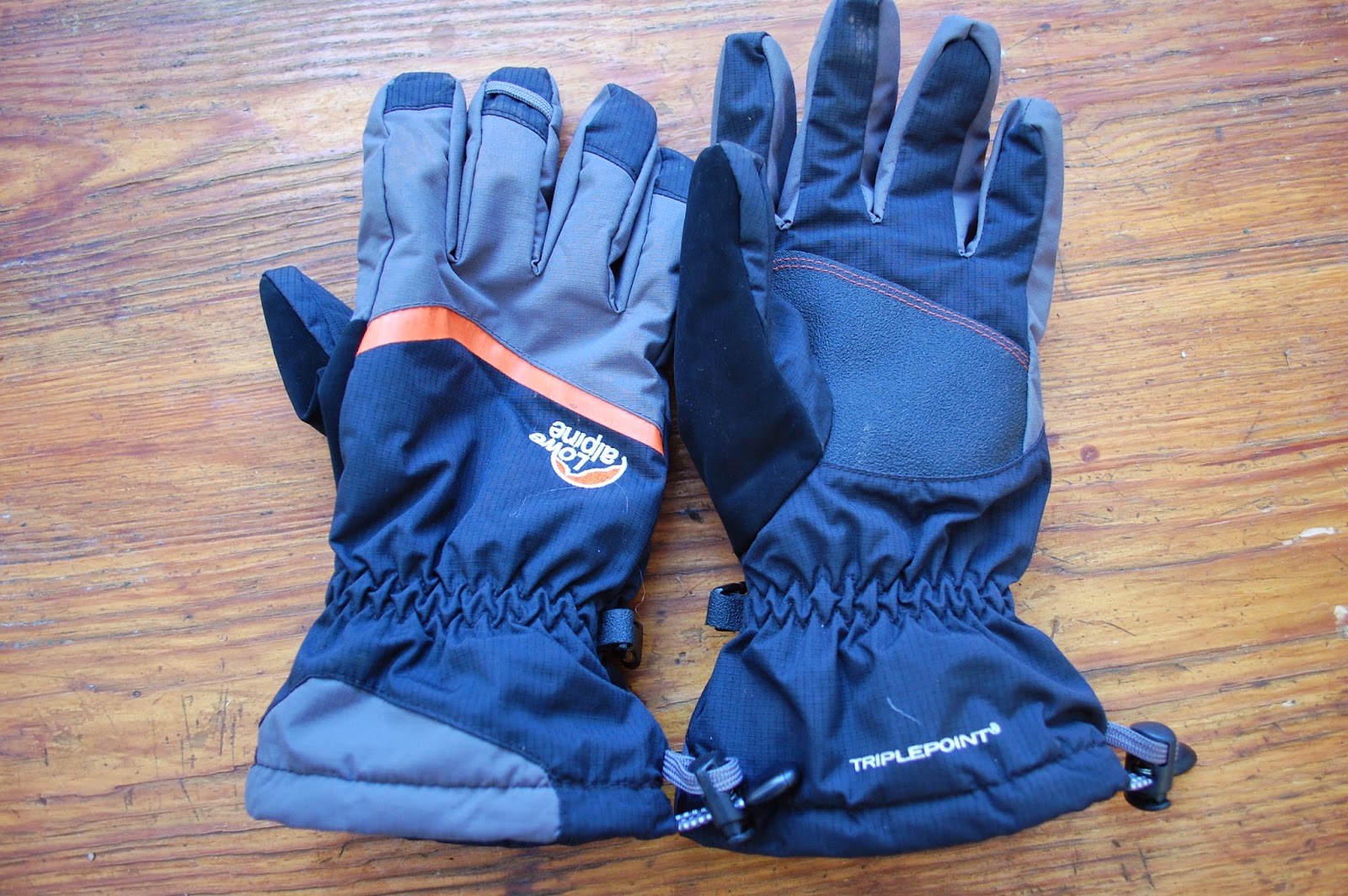
My immediate impression on changing into these was that they were not as warm as the Sealskinz. That may be a slightly unfair comparison as they're not designed for the same conditions, but it was the case nonetheless. The fit was looser than the Sealskinz making them feel less restricting, but this may have contributed to some of the heat loss. Even in the cold temperatures these gloves performed pretty well, just not as well as the Sealskinz, and my hands were comfortable enough.
The Storm Gloves allowed more dexterity than the Sealskinz as, despite their slightly bulky appearance I was able to manage zips and buckles easily.
Nearing the bottom of the ridge I decided that I would have to test the waterproofing claims of Lowe Alpine. Not having endured any rain though there was only one option...
 My hands stayed warm and dry throughout the expert construction work that went into this, suggesting that they are pretty waterproof. Sorry I can't be any more scientific than that, but I think the snowman test is a pretty reliable one!
Overall impressions
Both gloves have a comfortable soft lining and performed well in the cold and wind. The Sealskinz gloves were by far the warmest, but with an rrp of around £65 that's only to be expected; I was lucky to get mine at a real knockdown price. I'll be taking both pairs to Scotland with me and would be confident that either will do the job, but the Sealskinz will be my go-to pair for the coldest of days.
Sealskinz Extreme Cold Weather Gloves
I have to confess that I'm a big fan of Sealskinz kit, so when I saw a past-season model of these gloves for £12 on the Sealskinz outlet website it was just too good an offer to refuse (so good in fact that I got 2 pairs, one for Laura as well).
The fit was tighter on my fingers than I'm used to, but not uncomfortably so, and despite the thickness of the gloves I was able to use my hands for some tasks. When I overheated I was able to handle my down jacket zip, although the smaller zip on my merino baselayer proved too fiddly, forcing me to remove the gloves for this. Wrist leashes made this a quick and easy process though, with no danger of losing a glove in high winds. As soon as my hands were back in the gloves again they began to rewarm once more.
It didn't rain, so I couldn't test the manufacturers promises of waterproofing, but my experience of other Sealskinz products has been good in this area. If anything these gloves seem more robust than some of their other products giving me confidence that they'll keep the rain and snow out for some time.
Lowe Alpine Storm Gloves
I picked these up on sale a couple of months ago, again a past-season model. I'd worn them out and about a few times already but this was the first time they'd been used in temperatures hovering around zero coupled with strong winds.
My immediate impression on changing into these was that they were not as warm as the Sealskinz. That may be a slightly unfair comparison as they're not designed for the same conditions, but it was the case nonetheless. The fit was looser than the Sealskinz making them feel less restricting, but this may have contributed to some of the heat loss. Even in the cold temperatures these gloves performed pretty well, just not as well as the Sealskinz, and my hands were comfortable enough.
The Storm Gloves allowed more dexterity than the Sealskinz as, despite their slightly bulky appearance I was able to manage zips and buckles easily.
Nearing the bottom of the ridge I decided that I would have to test the waterproofing claims of Lowe Alpine. Not having endured any rain though there was only one option...
Overall impressions
Both gloves have a comfortable soft lining and performed well in the cold and wind. The Sealskinz gloves were by far the warmest, but with an rrp of around £65 that's only to be expected; I was lucky to get mine at a real knockdown price. I'll be taking both pairs to Scotland with me and would be confident that either will do the job, but the Sealskinz will be my go-to pair for the coldest of days.
Saturday, 17 January 2015
The Snowy Cat's Back
It's probably been two years or more since I last hiked Black Hill in Herefordshire. Now there seem to be several different high spots in the area all known as Black Hill, all even more confusingly located within The Black Mountains, which are of course found at the opposite end of the Brecon Beacons National Park from the entirely unrelated Black Mountain. For the avoidance of doubt, the hill I climbed today with Laura was the one more commonly known as The Cat's Back.
 There had clearly been a few people up before us this morning, and with pretty clear skies above it was easy to see why. The view from atop the ridge takes in the deep and remote Olchon valley to the west, while looking to the south and east a broad panorama stretches across Monmouthshire, Herefordshire and into Gloucestershire.
A mosaic of green fields, shaded subtly differently from one another, contrasted sharply with the brilliant white of the snow on the ridge. It seemed a world away although we had only walked a short distance.
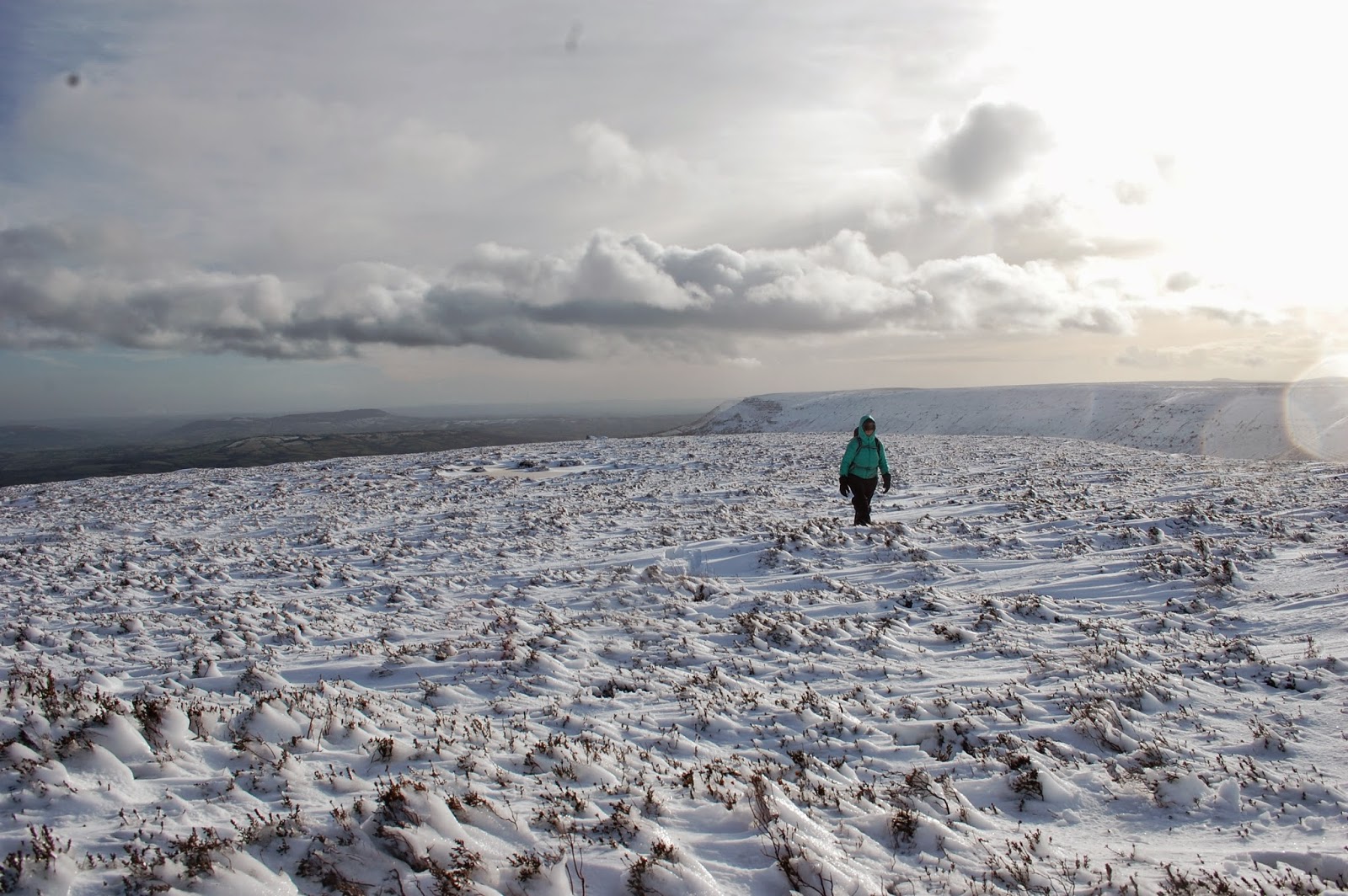 A strong and chilly westerly breeze gained in strength as we continued along the ridge and with the path straying close to the easternmost edge of the ridge, we decided to move towards the centre. We found a frozen bog that in spring would have been close to impassable. With a crisp coating of snow on the surface though, we were able to make good progress, even though it came to knee deep on a few occasions!
After skirting around a few frozen ponds we caught sight of the trig point marking the top of the hill and made straight for it. The wind had gently sculpted the snow into some beautiful formations in a couple of places, so I took a couple of snaps of one of my favourite: a rippled effect that reminded me of an oyster shell.

Snowy tracks
We made slow progress initially, slip-sliding up the steep prow of the hill through a mixture of fresh-fallen snow and mud that was both the colour and consistency of diarrhoea. Thankfully we'd both had our breakfasts before this thought occurred. The climb took us past a small group of hardy-looking hill ponies, seemingly not bothered by the near-freezing temperatures and as we rose higher we gained the ridge proper.A mosaic of green fields, shaded subtly differently from one another, contrasted sharply with the brilliant white of the snow on the ridge. It seemed a world away although we had only walked a short distance.
A knee-deep frozen bog
After skirting around a few frozen ponds we caught sight of the trig point marking the top of the hill and made straight for it. The wind had gently sculpted the snow into some beautiful formations in a couple of places, so I took a couple of snaps of one of my favourite: a rippled effect that reminded me of an oyster shell.
And then back down
We didn't have a great deal of time on our hands, so rather than heading around to the next ridge we were content to return by the same route. It seemed that we timed our walk about right, as we had the hill to ourselves all the way to the top, but then passed 4 or 5 groups during the descent as the afternoon sun began to melt the thinnest patches of snow.Thursday, 15 January 2015
Kayaking the Barle
Saturday found me on another new river; this time it was the Barle in north Devon. Diverted away from the Severn Bridge due to high winds, we were late getting to the put-in at Simonsbath, and with short winter days still prevailing, we wanted to push on. The river had other ideas.
The joy of tree-ridden diches
The stretch immediately below the bridge was a tree-filled nightmare, which heavy rain that morning had turned into a fast-flowing tree-filled nightmare. We only made it a couple of hundred metres before having to get out and portage, then after a second launch attempt had to portage once more. An overhanging tree caught out one of the group, so we had an early swim to deal with.
Even when the river widened out and the trees disappeared, a series of fences to keep the sheep in hampered our progress even more. Despite the slow progress, this was still an enjoyable section to paddle due to the bleak and beautiful moorland setting all around us.
At the 5th fence we had another swim and a pinned boat to recover, which turned out to be a little easier than it looked, but nonetheless we were not making good time. It was early afternoon by the time we reached Withypool and the beginning of the whitewater sections of the river.
Bouncy wave-trains
Downstream of Withypool the river gained in interest, with boulder-formed rapids blended together with short sharp s-bends in the watercourse. These required quick reactions once or twice when low-hanging trees reached far out into the current, and we duly had a third swimmer on one of the bends. A final fun wave-train led us close to the cable across the river where we portaged again, just above the ancient Tarr Steps.
Fast and furious
With less than two hours of daylight remaining, a few of the group chose to wait at Tarr Steps while four of us charged down the final stretch to fetch the cars. Taking a 'read and run' approach this was one of the best sections of white water I've been on. Although there were few significant feature drops, the 5 miles or so between Tarr Steps and Dulverton was constant wave trains and mini-chutes.
In the gathering darkness I capsized and rolled twice, hitting a rock the first time and catching my paddle on an overhanging tree on the second. Racing to reach the get-out before the sun disappeared though, there was no time to stop and play. It's definitely a stretch of water I'd return to.
Sadly, having brought her new go-pro with her, Laura then discovered that the battery wasn't fully charged, so no snaps of the day this time!
The joy of tree-ridden diches
The stretch immediately below the bridge was a tree-filled nightmare, which heavy rain that morning had turned into a fast-flowing tree-filled nightmare. We only made it a couple of hundred metres before having to get out and portage, then after a second launch attempt had to portage once more. An overhanging tree caught out one of the group, so we had an early swim to deal with.
Even when the river widened out and the trees disappeared, a series of fences to keep the sheep in hampered our progress even more. Despite the slow progress, this was still an enjoyable section to paddle due to the bleak and beautiful moorland setting all around us.
At the 5th fence we had another swim and a pinned boat to recover, which turned out to be a little easier than it looked, but nonetheless we were not making good time. It was early afternoon by the time we reached Withypool and the beginning of the whitewater sections of the river.
Bouncy wave-trains
Downstream of Withypool the river gained in interest, with boulder-formed rapids blended together with short sharp s-bends in the watercourse. These required quick reactions once or twice when low-hanging trees reached far out into the current, and we duly had a third swimmer on one of the bends. A final fun wave-train led us close to the cable across the river where we portaged again, just above the ancient Tarr Steps.
Fast and furious
With less than two hours of daylight remaining, a few of the group chose to wait at Tarr Steps while four of us charged down the final stretch to fetch the cars. Taking a 'read and run' approach this was one of the best sections of white water I've been on. Although there were few significant feature drops, the 5 miles or so between Tarr Steps and Dulverton was constant wave trains and mini-chutes.
In the gathering darkness I capsized and rolled twice, hitting a rock the first time and catching my paddle on an overhanging tree on the second. Racing to reach the get-out before the sun disappeared though, there was no time to stop and play. It's definitely a stretch of water I'd return to.
Sadly, having brought her new go-pro with her, Laura then discovered that the battery wasn't fully charged, so no snaps of the day this time!
Tuesday, 6 January 2015
A Walk on the Newport Levels
I took the opportunity of a sunny day today to do a bit of a recce / research walk for a magazine article I'm working on. With my focus normally set in the hills and mountains, I forget sometimes how lucky I am to live by the Severn Estuary with its wide horizons, diverse wildlife and scenery that changes with every tide.
I headed out from the Newport Wetlands Reserve; a strangely calm wildlife haven in the shadow of Uskmouth power station and within earshot of the M4. Thick reed beds obscured any kind of view for the first 5 minutes or so until I climbed up onto the sea defence wall, topped by a small lighthouse. The early morning clouds had almost completely disappeared within 30 minutes, and I was soon overheating in my winter layers.
 The tide was on the way out, so already there were slick rainbows reflected in the thick and greasy mud and with little wind present it was hard to tell where the mud ended and the dark river began.
I could quite happily have spent the morning wandering along the flood defences, but unfortunately my path was barred two kilometres in. It seems that some of the birds in the reserve are more delicate than others, so a large swathe of the area is out of bounds. That meant a long diversion inland for me, eventually re-emerging on the sea wall at Goldcliff. The sea defences there looked as though they had been spray-painted yellow, with mottled patches all along the boulders beneath me, and even a few spots on the track itself. The air must have been very clean, as the yellow dots were in fact large colonies of lichen exposed by the low tide.
 The walk became more of an inland mud-fest soon afterwards as I began to loop back across semi-flooded fields in an effort to avoid retracing my steps. I came across a few flocks of unusually assertive sheep, with one group running around behind me in order to follow me all the way to the gate of their field. I guessed that there must be a few pregnant ewes within the flock for the other sheep to be behaving so defensively, and the next flock even had a very early lamb within it.
Despite the mud, the walk was pleasant enough, and gave me the opportunity to sample a small section of the Wales Coast Path, and see off a few of those Christmas pounds!
I headed out from the Newport Wetlands Reserve; a strangely calm wildlife haven in the shadow of Uskmouth power station and within earshot of the M4. Thick reed beds obscured any kind of view for the first 5 minutes or so until I climbed up onto the sea defence wall, topped by a small lighthouse. The early morning clouds had almost completely disappeared within 30 minutes, and I was soon overheating in my winter layers.
I could quite happily have spent the morning wandering along the flood defences, but unfortunately my path was barred two kilometres in. It seems that some of the birds in the reserve are more delicate than others, so a large swathe of the area is out of bounds. That meant a long diversion inland for me, eventually re-emerging on the sea wall at Goldcliff. The sea defences there looked as though they had been spray-painted yellow, with mottled patches all along the boulders beneath me, and even a few spots on the track itself. The air must have been very clean, as the yellow dots were in fact large colonies of lichen exposed by the low tide.
The walk became more of an inland mud-fest soon afterwards as I began to loop back across semi-flooded fields in an effort to avoid retracing my steps. I came across a few flocks of unusually assertive sheep, with one group running around behind me in order to follow me all the way to the gate of their field. I guessed that there must be a few pregnant ewes within the flock for the other sheep to be behaving so defensively, and the next flock even had a very early lamb within it.Despite the mud, the walk was pleasant enough, and gave me the opportunity to sample a small section of the Wales Coast Path, and see off a few of those Christmas pounds!
Wednesday, 31 December 2014
More Welsh Water (not the kind that comes out of the tap)
Had another great day on the river yesterday paddling the Sennybridge to Aberbran section of the Usk, my first time that far up the river. Although the river was pretty low, the three signature drops on the section were still loads of fun, and made up for one or two sections being a bit of a boulder-filled 'adventure'. Will did a fine job of catching much of the trip on his Go-Pro, with a write up and footage on his blog here.
Subscribe to:
Posts (Atom)