Search This Blog

Showing posts with label Scotland. Show all posts

Sunday, 5 April 2015

Scottish Winter: Part 2

It's been another busy week here in the Wye Valley. Six days in the Brecon Beacons training a Duke of Edinburgh Award group means I've only just found the time to finish this off, so here goes: part 2 of the Scottish Winter Skills course.

Ropey Business

The penultimate day of the course began with more fairly clear skies and a good forecast for our walk up to Stob Coire Nan Lochan. Two of the 'Three Sisters' of Glencoe, the dramatic northern ridges of Bidean Nam Bian, converge to form the top of the mountain. After putting on crampons we made our way onto the middle of the three, Gearr Aonoch and ascended the narrowing ridge through atmospheric drifts of low cloud and mist. Nearing the top, the cloud parted enough to enable a view into the Hidden Valley to the east, where the Clan MacDonald used to hide their stolen cattle. I've heard it referred to as one of the most beautiful valleys in the area, but unfortunately didn't get the chance to explore it this time.

At the top of the mountain Adele taught us a couple of basic techniques for descents. Abseiling was a new technique for a couple of group members although not for me. Building a stomper belay was definitely something new for me though. The technique consisted of driving an axe shaft into the snow and running a rope through a carabiner attached close to the axe head in order to lower somebody else. It was quicker and easier to set up than I had expected, and although it relied on nothing but a bit of snow as an anchor, seemed to work remarkably well, definitely a skill worth knowing!

From Walking to Mountaineering

Our final day was spent back on Ben Nevis where we enjoyed the clearest day of the course. The walk in to the snowline gave us the opportunity to pick out several of the classic routes onto the mountain. Tower Ridge and Castle Ridge both appealed to me, and are definitely routes I'd like to tackle in the summer.

We headed around to the western side of the coire though and made for number 4 gully. Usually a descent route, this snow filled chute provided us with a first taste of winter climbing, at an easy grade 1. The first half of the route was fairly straightforward and we made good progress kicking steps into the snow. As the gully steepened though, we stopped and roped up. Working as a pair and a three, we 'trainlined' up the gully, keeping a tight rope between each group as we climbed, using a pair of axes in the hardening snow. 

I found climbing with 2 axes more tiring than I had expected, but before long we were all on the top, enjoying the mid afternoon sunshine. With the summit around 45 minutes away we opted not to top out this time and made our way back down towards the Red Burn and on to the car park again.

Part 3?

Five days in the Scottish Winter left me with a few basic skills, a couple of blisters, a touch of sunburn and a glimpse of what motivates so many people to head for the hills in winter. I hope I'll be back next winter, better prepared and more confident to tackle the mountains of Glencoe and Lochaber.

Wednesday, 25 March 2015

Winter in Scotland

Winter walking is something that has almost entirely passed me by until recently. A trip to New Zealand last year found me trekking to the snowline of some of the country's highest peaks, but feeling as though I was missing out by not going further with an axe and crampons. So when I got the opportunity to take part in a BMC Scottish winter skills course in Glencoe and Lochaber, where I'd hoped to go in October I quickly signed up.

All the Gear

Working and playing in the outdoors can be an expensive business. I've spent years building up a stock of kit for climbing, paddling, caving, hillwalking, camping... so I was a little hesitant about getting into another new activity. I managed to borrow an axe and crampons from a friend though, so was left to buy a pair of winter boots second hand on Ebay! Normally I wouldn't advocate buying used boots, but they were cheap enough that I could afford to get rid if they didn't fit well. Fortunately they were a pretty good fit, although I did pick up a couple of small blisters.

No Idea

I reached the Alex McIntyre Hut on the Friday evening and, chatting to some of the other attendees I have to admit I felt a little out of place. I'm pretty sure I was the only person there who'd never used crampons before, and several other participants had a fair bit of experience already. Most of the others seemed to be there to sharpen up existing skills, but I was starting from scratch. 

Fourteen participants were split into five groups: Three pairs were there for a winter mountaineering weekend, tackling technical climbing routes in the area while the remainder of us had signed up for winter walking. Four of us had arranged to stay on for the three-day extension course after the weekend.

A Sunny-Snowy Start

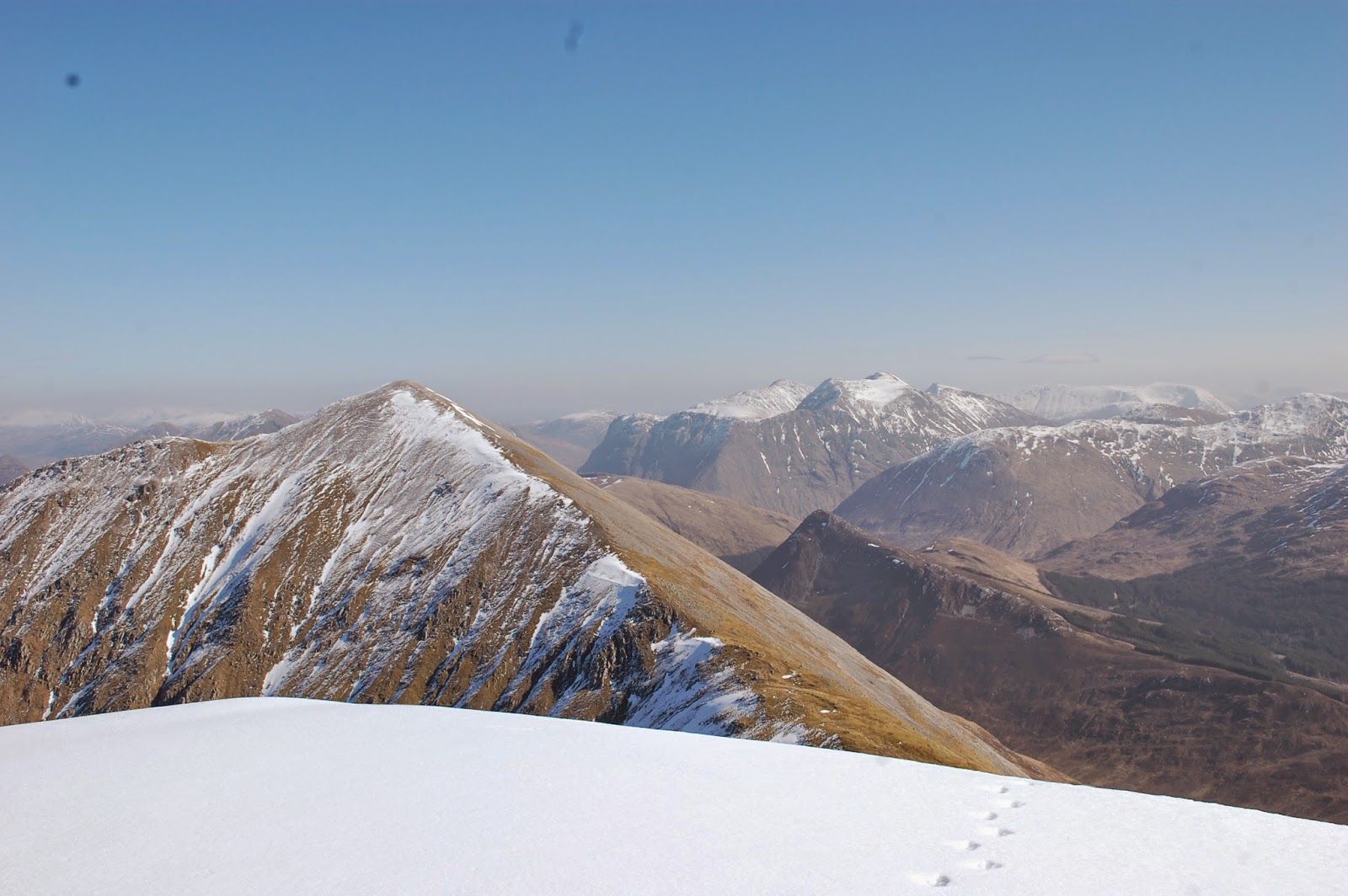
Clearing skies greeted us on the first morning of the course, and by the time we had warmed up on the stony track up Buchaille Etive Beag, the sun had appeared, making for a pleasantly surprising warm winter's day. The original plan was for some ice axe arrest practice on the lower slopes of the hill, but our instructor Nick suggested we make the most of the fine weather and hit the summit first. Glorious sunshine remained as we donned our crampons and made our way up a snow-covered ridge to the top. A little out of breath but happy nonetheless, we were rewarded with views into Glen Etive and across the rolling hills beyond. 

I enjoy the UK Hills whenever I'm out walking, and I'm a big fan of the Ogwen Valley in Snowdonia, but this was something else entirely. In Ogwen you can climb to some beautiful high tops, but are always aware of the roads cutting through the valleys below. Looking south from Buchaille Etive Beag, the mountains just seemed to go on endlessly, tailing away into the distance. It felt like somewhere truly special.

Making our way back down the hillside, the weather stayed fine and we caught up on the missed skills session, tumbling down a snow-covered slope and learning to stop using the ice axe from all sorts of different angles.

Making Progress

The second day, on the Ballachulish Horseshoe, was equally sunny but there was less snow in evidence. The long walk in and out through a forest took a little away from this day, but the views from the high ridge across to a cloud-free Ben Nevis on the way up helped to make up for the duller parts of the day. At the end of the day it was time to have a chat with the excellent Adele Pennington, a highly experienced mountaineer and our instructor for the next three days.

Several options were discussed for the next few days, but a favoured option was to tackle the CMD Arete, the narrow ridge leading up onto Ben Nevis from the north. This was a route I'd hoped to tackle in the summer at some point, so I was excited about the thought of having a go now in late winter.

The weather forecast was pretty good the next day, but as we slogged up Carn Dearg, low cloud obscured the arete and threatened poor visibility all the way. As we began to traverse the ridge, taking care to stay close to its crest, a little snow began to fall, blowing onto the left side of my face and freezing in my beard! The clouds parted briefly beneath us, allowing a view down to the coire far beneath us and offering a reminder of the seriousness of the route. The walking was easy, but the consequences of a slip would have been severe.

At the end of the arete we plodded slowly uphill towards the summit of Ben Nevis, eventually reaching the trig point, almost buried beneath several metres of snow. A few minutes rest in the cold was all we had time for before heading back down, following bearings to take us away from the dangerous gullies on either side and safely off the summit.

From winter walking on the CMD, we moved on to something a little more adventurous. More on that another time.

Sunday, 21 December 2014

Thoughts on a mountain tragedy

The professional outdoor world has been ablaze with debate and discussion over the past few days, thanks to the findings of a fatal accident report by a Scottish Sheriff.

The full judgement can be found here, but in summary, the inquiry concerned the death in 2012 of Graham Paterson, an experienced hillwalker and climber who was self employed, taking clients out in the hills of Skye. Although Mr Paterson had been taking clients out since 1995-96 and has been referred to as a mountain guide, he did not hold any formal qualifications in this area. This forms the background to some of the Sheriff's recommendations.

Mr Paterson fell on a grade 4 winter climb, in the company of a client who had asked for, and thought that she was going on a winter walk. When the accident occurred, the client did not know which mountain she was on, let alone the exact location, and Mr. Paterson was badly injured and unable to tell her. With considerable difficulty and at considerable personal risk, the client was able to descend the mountain and summon help.

Evidence was given by a local MIC holder and by the deputy head of the Scottish Adventurous Activity Licensing Service (AALS). Both were unequivocal that the client should not have been on the route she was, given her own stated level of experience, and that furthermore she should have been more involved in the route planning, as well as being provided with emergency procedures.

The Sheriff states in his report that 'the underlying cause of the risks to which (the client) was exposed was the unregulated nature of mountain guiding in Scotland' and that 'it is incumbent upon policy makers to discover a means by which mountain guides in Scotland are properly qualified and equipped to provide the service which they promote and which they operate for commercial gain'

This is no knee jerk reaction, the likes of which can be seen in the uninformed comment of the Daily Mail every time there is a death in the mountains. The Sheriff did not call for a minimum level of qualifications, nor did he call for the banning of non-professionals from the mountains and uplands of the UK. Instead, at a time when the UK government has been considering removing the requirement for licensing of outdoor activities for children, the Sheriff seems to call for the expansion of the AALS approach to the adult sector.

The current situation in law is that an outdoor professional can demonstrate their competence in a number of ways, including the use of formal qualifications. It is also possible to demonstrate competence through long experience. Where the competence-based route can fall down is in the area of continual professional development, in particular keeping up with developments in best practice and new technology. The licensing approach, with its emphasis on technical advisors, attempts to address this concern.

The distinction between children and adults that forms the basis of the AALS regime is based on the premise that adults are (or should be) more able to understand and assess the risks involved in an activity. When commercial services are engaged however, this process of risk assessment becomes blurred, and in practice, paying clients expect that risks will be managed for them.

So, licensing, a no-brainer right? Well, at a cost of £700+ for a 1-3 year license under AALS, many small providers are discouraged from taking on licensable activities. If this approach were extended into the adult market, how many small businesses would decide to pack it all in? Would we be left with a few big players taking people out on the same routes and offering a less than personal service, or would prices simply rise to absorb the licensing and technical advice fees?

There are no easy answers, and this case appears to be unusual rather than indicative of a wider problem amongst outdoor professionals, but I believe there is some wisdom in the cautious steer given towards licensing by the Sheriff. Regardless of the next steps though, there will always be risk in the mountains. The focus must remain on sound judgement and decision making, with external controls a secondary concern.

Thursday, 9 October 2014

Blowing a hoolie!

With cold, damp feet, an aching left knee and the rain still driving at my face, I reached the car park at 6.30PM. After 2 ill-advised days in the hills I was glad to get back to the car, but then I saw it. Glass. Shattered glass inside the car. My heart sank as I realised the car had been broken into in my absence, but with Laura waiting half way down the road the only thing for it was to drive down anyway, sitting on a heap of icy white cubes.

It didn't make sense though; my wallet was untouched, there was still gear on display in the back, and 2 pairs of approach shoes stashed in the footwells. There was no sign anyone had had a go at the radio either, and it was then that it dawned on me: it was the wind. 120mph winds were reported on the tops that day, and my car windows had fallen victim to a hail of supercharged gravel and stones, hurled at high speed against the glass until it shattered. With those kinds of forces unleashed over the hills that day it made me think that perhaps the last minute route change - trying to salvage something out of hazardously cold, wet and windy conditions - had been the wisest thing I had done all week.

The original plan was to walk the Lharig Ghru from the north, staying at the Corrour Bothy before heading up the Tailor Burn to Ben Macdui and a night on the Cairngorm plateau, heading back down again after 2 nights in the hills. The forecast though, stayed resolutely poor in the days leading up to the trip. High winds became a prediction of 100mph on the second day, when we would have been camping on the high ground, and rain was a constant.


The hasty revision found us staggering up Miadan Creag an Leth Choin, leaning comically into the wind and swaying like saturday night students. When we reached the slope leading to Cairn Lochan, it was bitterly cold, and with low cloud swirling down from the south, visibility was down to metres. I seriously considered turning back, particularly knowing that this was probably the worst conditions Laura had been out in, but with down jacket and new Gore Tex waterproof to shield her from the elements, she was loving every step.

"It's like a rollercoaster!" she yelled over the force of the wind, and so we plunged onwards into the mist-shrouded col below.

With a cloudy boulderfield between us and Macdui, the compass came out for the first time, confirming the route between several marker cairns to the base of the final climb, and thirty windswept minutes later we stood at the top. Surrounded by thick cloud and with increasingly heavy rain and wind chilling us through, there were no views to be had and the only proof of our location was to be found in the trig point.

Hastily consulted bearings took us down from the top to the vicinity of the Tailor Burn, which we intended to follow to the valley floor, but despite the heavy rain there was no sign of the stream, only a low lying area that I guessed must house its headwaters. The slope down was not as steep as I expected, but as the clouds dispersed below, I discovered why. In my haste, I had taken us slightly beyond Tailor Burn, and we almost dropped into the next coire to the south.

As evening approached, we reached the shelter of the Corrour Bothy, unoccupied but with a rucksack and sleeping bag inside, together with a note referring to a helicopter rescue the previous day. On that sobering thought, we collapsed into our sleeping bags and slept through the growing wind and rain hammering on the roof.

A relentless slog up the Lharig Ghru the following day brought no improvement in the weather, but at least we had a tailwind for most of the journey. Fine weather picnic spots seemed to appear everywhere, from the Pools of Dee to the steep chasm at the headwaters of Allt Druidh, but with such poor weather we had no incentive to stop.


Finally, as we passed through the impressive Chalamain Gap, the sun began to pierce the clouds, and a double rainbow appeared at the end of the boulder-filled canyon. What fine views remained of the day began to present themselves as we rounded the corner of Lurcher's Crag and made our way back towards the car park.


The weather was terrible, the car was badly damaged, but it can be repaired and the hills will still be there next year. And the year after...

Thursday, 2 October 2014

Unfinished Business and the Unpronounceable Scramble

We leave tomorrow. Six hours to Carlisle and the luxury of Travelodge. Another 4 hours to Aviemore where it all starts, or should that be continues?

Back in 2007, as a very green and inexperienced hiker grovelling away for a living in the kitchens of a PGL centre, I set out to climb Ben Macdui. A 9.30AM start in November probably wasn't the smartest of moves, but then again, who gets everything right first time around? I made it as far as the March Burn that time, before the thickening cloud and fine drizzle soaking through my Regatta 'waterproof' sent me scuttling back to the car park before dusk fell. I've been exiled from Scotland ever since.

Tomorrow I travel back to the Cairngorms, courtesy of a long running card game competition with Laura: if she won, we agreed to go to Alton Towers. My prize was the Cairngorms, or maybe Skye, or some other place in Scotland. Secretly it was always about the Cairngorms; I felt I had failed first time around, even if turning back was the right decision. With a slightly older and greyer head on my shoulders now though, Ben Macdui would be great, but it's not the only game in town.

Despite the poor forecast for the week we're going to give the West Highlands a shot too. A friend who knows about these things recommends Aonach Eagach, which coincidentally is the sound I made last time I had a gut infection. Cowardice being the best part of valour, we'll have to see how it all pans out. Plenty more to do if that all goes belly up.

Watch this space...